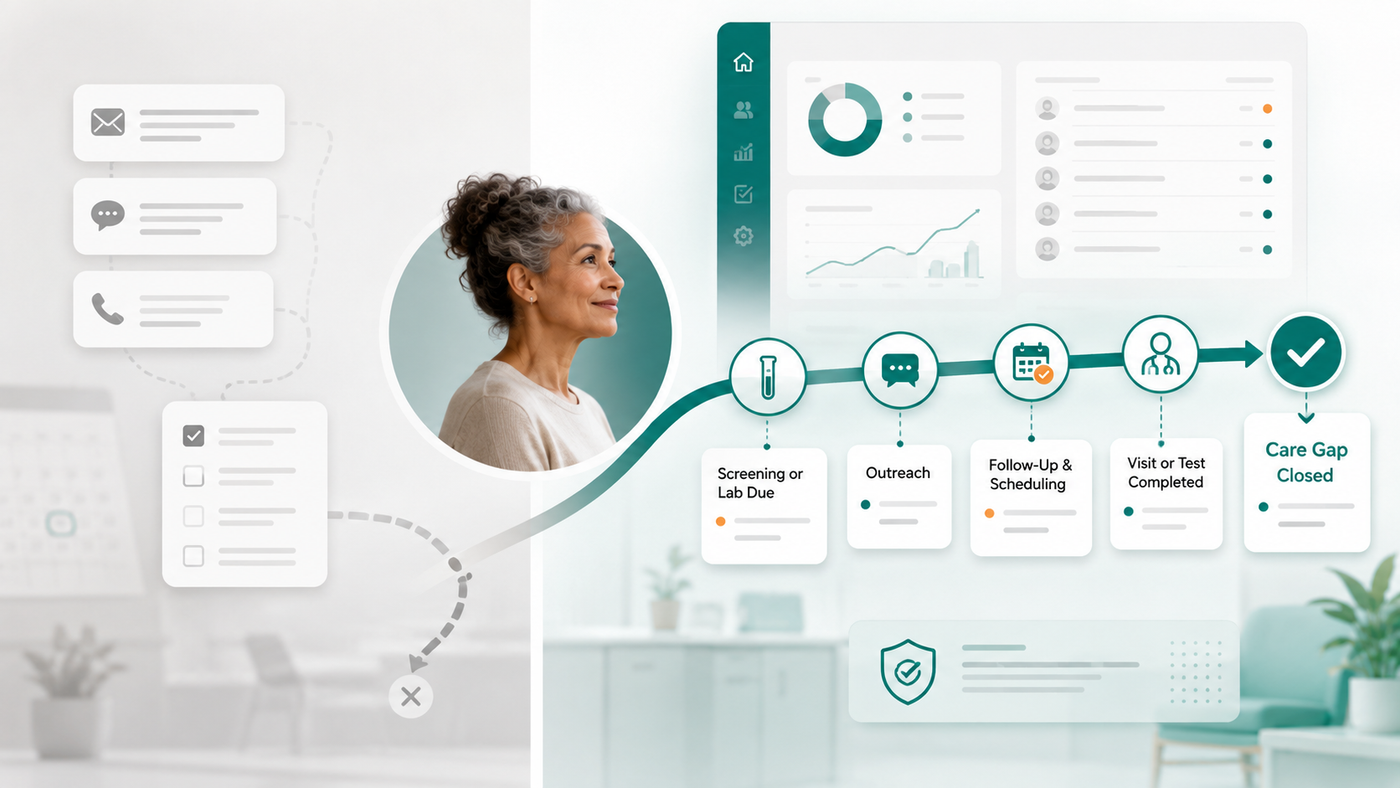
Preventive care gaps rarely persist because a clinician forgot to recommend a screening, lab, or referral.
More often, the recommendation was made. The order was placed. The patient was told what to do.
Then the visit ended.
That is where many preventive care workflows break down.
A reminder campaign can make a patient aware that something needs to happen. But closing a preventive care gap requires continued follow-through until the screening, lab, referral, or other preventive action is actually completed and documented.
That is the difference between campaign-based outreach and persistent preventive outreach.
Preventive care is not only a notification problem.
It is a longitudinal follow-through problem.
Why Preventive Care Gaps Persist
The scale of the problem is substantial.
The Centers for Disease Control and Prevention reported that only about 8% of adults aged 35 or older received all recommended high-priority preventive services, while nearly 5% received none.
Access also remains uneven. Even among people who report receiving routine checkups, uninsured and lower-income populations are less likely to receive recommended preventive services.
Inside a practice, the breakdown often looks much simpler:
- A screening is ordered but never completed.
- A lab is recommended but never scheduled.
- A referral is placed but the patient never sees the specialist.
- A patient does not answer the first outreach attempt.
- A reminder is sent, but nobody verifies whether the next step happened.
- A service is completed elsewhere, but the result never makes it back into the chart.
The clinical recommendation happened.
The care gap remained open.
The Limitation of Campaign-Based Patient Outreach
Many patient-engagement platforms support preventive outreach through automated reminders and campaigns.
For example:
- Tebra supports automated appointment reminders and recall campaigns.
- NexHealth combines recall messaging with online scheduling.
- Klara supports personalized broadcast outreach and patient communication workflows.
- OhMD supports broadcast messaging and two-way texting.
These tools can make communication easier and reduce manual phone calls.
But a campaign and a closed-loop workflow solve different problems.
A typical campaign might:
- Identify a group of patients.
- Send an initial reminder.
- Send one or two follow-ups.
- End after a predetermined sequence.
If the patient takes action, the campaign worked.
If the patient does not, the unresolved gap may simply return to a report or patient list.
The system successfully sent the message.
It did not necessarily ensure that the underlying task was resolved.
Why Reminders Alone Are Not Enough
Reminders clearly have value.
A Cochrane review summarized by the American Academy of Family Physicians found that text-message reminders improved appointment attendance compared with no reminders.
Targeted reminder calls have also reduced no-show rates among higher-risk patients in randomized trials.
So the problem is not that reminders do not work.
They do.
The problem is that improving response or attendance is not the same as closing a preventive care gap.
Consider a colorectal cancer screening recommendation.
The patient may need to:
- Receive the recommendation.
- Understand why it matters.
- Agree to proceed.
- Receive or schedule the appropriate screening.
- Complete it.
- Have the result returned to the practice.
- Have the completion documented in the medical record.
A reminder may help with one step.
The care gap closes only when the workflow reaches the end.
What Is Persistent Preventive Outreach?
Persistent preventive outreach treats an unresolved care gap as an active piece of work, rather than a message that needs to be sent.
The workflow continues until there is a defined outcome.
That might mean:
- The screening was completed.
- The laboratory work was completed.
- The referral appointment occurred.
- The patient declined.
- The service was completed elsewhere.
- A clinician determined the service was not appropriate.
- The patient requires another form of follow-up.
Instead of asking, “Did we send the reminder?” the system asks:
“Has this preventive care task actually been resolved?”
That distinction changes how the workflow is designed.
What Closed-Loop Preventive Outreach Looks Like
A persistent preventive workflow can include several components.
1. Keep unresolved gaps open
The task should not disappear because one outreach sequence ended.
If the patient has not completed the recommended action, the gap remains visible.
2. Retry outreach over time
Not every patient responds on the first attempt.
Persistent workflows can retry outreach at appropriate intervals rather than treating silence as completion.
3. Change the next step based on the patient response
A patient who says, “I already completed this somewhere else,” needs a different workflow from a patient who says, “I cannot afford it,” or a patient who never responds.
Patient responses should change what happens next.
4. Escalate when human intervention is needed
Automation should not attempt to resolve every situation.
Some responses need staff or clinician review, such as:
- New symptoms
- Questions about whether a screening is appropriate
- Patient refusal
- Barriers to access
- Conflicting clinical information
- Repeated nonresponse in a higher-risk patient
5. Capture completion
The workflow should record when the preventive action is actually completed.
Without that step, practices may continue contacting patients whose gaps have already been resolved.
6. Document the outcome
Completion, refusal, outside completion, contraindication, or another resolution should ultimately be reflected in the clinical record.
That is what converts outreach activity into a closed loop.
Campaigns Are Time-Bound. Persistent Workflows Are Outcome-Bound.
This is the core distinction.
A campaign usually asks:
How many messages should we send?
A persistent workflow asks:
What needs to happen before this task can be considered complete?
That changes the unit of work from a message to an outcome.
Instead of:
Send mammography reminder.
The task becomes:
Resolve mammography care gap.
Instead of:
Remind patient about referral.
The task becomes:
Determine whether the referral was completed and document the outcome.
Instead of:
Send lab reminder.
The task becomes:
Follow through until the ordered lab is completed, declined, or otherwise resolved.
This is a small architectural difference with a large operational consequence.
Preventive Care Requires More Than Outbound Messaging
Preventive follow-through is also rarely a one-channel problem.
A patient may:
- Reply by text.
- Ignore texts but answer a phone call.
- Call the practice back later.
- Ask to schedule the service.
- Report that it was already completed.
- Need a staff member to intervene.
- Require a different next step based on new information.
A closed-loop system therefore needs to do more than send outbound reminders.
It needs to support the conversation and workflow that happen after the reminder.
That means connecting outreach with:
- Patient responses
- Scheduling
- Staff work
- Clinical review
- Follow-up tasks
- Completion status
- Documentation
The message is only the beginning of the workflow.
Preventive Care in a Value-Based Environment
Preventive care performance increasingly matters beyond the individual encounter.
More than 45% of hospitals and health systems participate in value-based payment arrangements, while CMS continues to expand accountable and value-based care models.
Preventive screening and care-gap performance can influence:
- Quality measures
- Population health performance
- Shared-savings opportunities
- Preventive care metrics
- Health-equity initiatives
That makes consistency increasingly important.
A practice cannot reliably improve preventive performance if success depends on an employee remembering to revisit a spreadsheet or manually regenerate the same outreach list.
The workflow itself needs to preserve unresolved work.
Questions to Ask When Evaluating Preventive Outreach Software
When evaluating a preventive outreach platform, asking whether it can send SMS messages or automated reminders is not enough.
More useful questions include:
- What happens when the patient does not respond?
- Does an unresolved care gap remain active?
- Can outreach retry automatically?
- Can the workflow change based on the patient's response?
- Can staff intervene when necessary?
- Can patients call or message the practice back?
- Can the system help move the patient toward scheduling or completion?
- Does it track whether the preventive action actually happened?
- Can staff document declines, contraindications, or outside completion?
- Does the outcome make it back into the clinical workflow?
Those questions reveal whether a product is primarily a communication system or a system for longitudinal follow-through.
From Patient Outreach to Longitudinal Care Operations
This is the broader problem Chronii is designed around.
Healthcare teams already know which patients need follow-up.
The difficult part is maintaining that follow-through across hundreds or thousands of patients while clinical work continues every day.
Chronii uses AI voice and text outreach, patient-specific tasks, scheduling, staff handoffs, and EHR-embedded workflows to help practices keep unresolved patient work moving between visits.
The goal is not simply to automate more messages.
It is to make sure the next step does not disappear after the message is sent.
The Bottom Line
Preventive care gaps do not close because a reminder was delivered.
They close when the underlying task reaches an outcome.
Campaigns can create awareness.
Persistent workflows create accountability.
For practices trying to improve preventive care at scale, that distinction matters. The most important question is no longer:
“Did we contact the patient?”
It is:
“Did the care gap actually get resolved?”